Who We Work With
Trusted by government, academia, and industry









12+ years. 120,000+ connected vehicles. More time with more transport data than anyone else in the country. When nationwide eRUC arrives, the organisations that fund and manage New Zealand's roads will need this experience more than ever.
No one in New Zealand has spent more time working with national-scale telematics datasets. We handle full-scale data ingestion with a privacy-first approach, aligned with government data standards and ready for what comes next.
Every dataset is aggregated and anonymised before analysis. We follow national data ethics and stewardship frameworks, ensuring no identifiable trip data is ever released. Privacy is embedded at every stage — not bolted on afterwards.
We start with your specific transport question and design outputs that answer it precisely. No generic dashboards. Whether it's freight corridor resilience, road safety risk, or infrastructure impact — the analysis fits the problem.
More than 12 years of experience working with telematics and transport datasets. Full-scale data ingestion readiness, integration with existing transport models, and a foundation built on trusted compliance with government and academic partners.
Today, eRUC applies to diesel and heavy vehicles. When it extends to the entire fleet, every vehicle on New Zealand's roads will generate telematics data. The volume of connected vehicle data will increase by an order of magnitude.
That data is only valuable if it can be aggregated, anonymised, and translated into intelligence that road controlling authorities, planners, and policymakers can act on. That is exactly what Robinsight has been doing for over a decade.
Our vision: a shared, privacy-first dataset that multiple eRUC providers contribute to — powering better insights than any single provider could produce alone. More data from more sources means richer coverage, stronger evidence, and smarter decisions for the organisations that build and maintain New Zealand's transport network.
If you're an eRUC provider preparing for this transition, we'd welcome the conversation.
From freight corridor resilience in the United States to road safety analytics in New Zealand — our work spans government policy, infrastructure planning, and academic research.
Oregon State University
Developed and validated freight disruption indicators that quantify corridor resilience using real-world operating data, enabling state transportation agencies to identify critical network links for investment.
Read case study →
EROAD
Processed 14 billion telematics records to build New Zealand's first nationwide curve risk index, identifying dangerous curves through driver behaviour patterns before crash statistics reveal the risk.
Read case study →
Hamilton City Council
Quantified freight route shifts and travel time improvements following the Waikato Expressway opening, providing robust evidence to validate the infrastructure investment.
Read case study →
Ministry of Transport
Delivered weekly telematics-based freight intelligence to the Ministry during the pandemic, directly informing ministerial briefings and targeted policy measures to keep essential supply chains moving.
Read case study →
Ara Ake
Analysed trip distance distributions from fleets nationwide to underpin Ara Ake's public-facing decarbonisation model, enabling fleet operators to assess realistic low-emission vehicle options.
Read case study →
Waka Kotahi
Demonstrated how telematics-based road usage analysis can improve the fairness of National Land Transport Fund allocation by linking maintenance budgets to actual heavy vehicle impact.
Read case study →We work with telematics data from regulatory-approved electronic road user charging (eRUC) providers. All datasets are validated for accuracy and compliance before analysis begins.
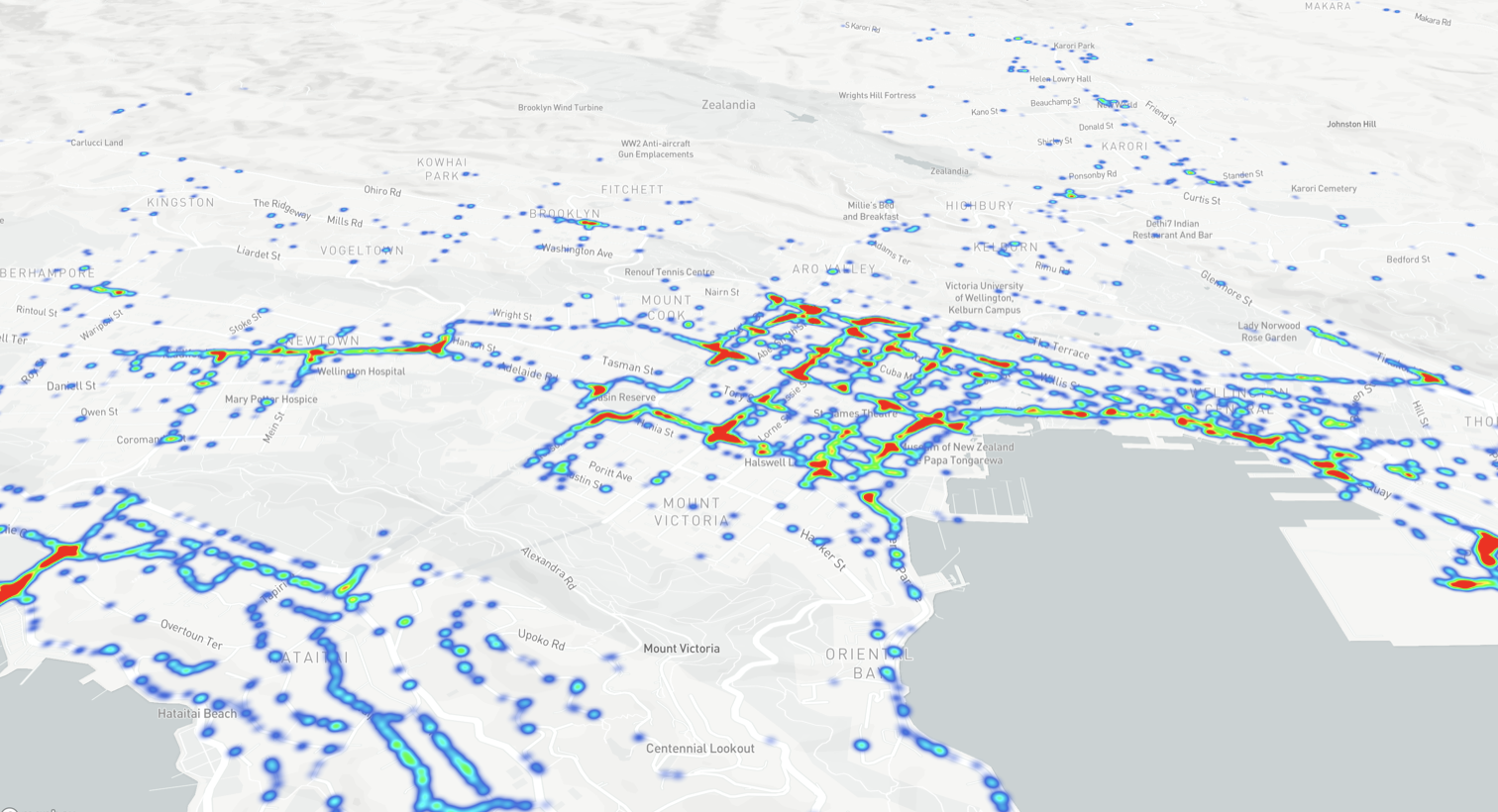
Traditional traffic counts capture volume at fixed points. Telematics data captures complete trip behaviour — origins, destinations, routes, speeds, and dwell times — across the entire network, continuously. This means richer context, stronger evidence, and insights that surveys simply cannot provide.
Our core dataset draws from over 120,000 connected vehicles in New Zealand and 200,000 globally. In New Zealand, that represents more than 40% of the heavy vehicle fleet — far beyond what any traditional survey programme could capture.
Coverage spans every region of New Zealand, with strong sampling across urban, rural, and inter-regional networks. For freight, our penetration rate is unmatched. The result is data that reflects real-world vehicle behaviour at scale — not a snapshot from a single survey period.
Most projects are delivered within 2–6 weeks, depending on data complexity and scope. We start with understanding your specific question and design the analysis to fit.
Yes. We align data from different telematics and sensor sources to common aggregation frameworks — whether that's a road network, statistical area, or corridor. From small CSV datasets to billions of records on an event stream.
Routinely. We process billions of data points across multiple years, regions, and datasets. Our work spans New Zealand and international freight networks.
Identifiable trip data is never released. All outputs are aggregated to statistical areas, road segments, or corridors. We apply reverse-engineering protections to prevent indirect identification. This privacy-first approach is embedded at every stage of analysis — it is not optional.
Road safety risk analysis, freight corridor performance, infrastructure impact assessment, emissions estimation, transport model calibration, and policy evaluation — all tailored to your specific requirements and delivered in formats ready for decision-making.